
Follow us and share your results!
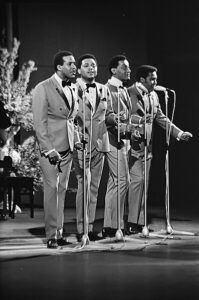
About Four Tops
The Four Tops, hailing from Detroit, Michigan, are an iconic American vocal quartet known for their significant influence on the Motown sound of the 1960s. Comprising four members – Levi Stubbs, Abdul “Duke” Fakir, Renaldo “Obie” Benson, and Lawrence Payton – they embarked on their journey as a group in the early 1950s and remained remarkably consistent, performing together until 1997 without any changes in their lineup.
Originally known as the Four Aims, the group’s name changed to the Four Tops to avoid confusion with another musical act, the Ames Brothers. Despite their early struggles with record labels like Chess, Red Top, Riverside Records, and Columbia Records, the Four Tops persevered. Their relentless touring and polished stage presence helped them develop a strong following and a reputation as an exceptional live act.
Signing with Motown
In 1963, their fortunes took a turn for the better when they caught the attention of Berry Gordy, Jr., the founder of Motown Records. Signing with Motown marked a significant milestone in their career, as they would soon become one of the label’s most iconic acts.
During their initial years at Motown, the Four Tops recorded jazz standards for the Workshop Jazz Records label and provided backing vocals for fellow Motown artists like the Supremes and Martha and the Vandellas. However, it was the magic of the legendary songwriting and production team, Holland–Dozier–Holland, that truly catapulted them to stardom.
One of their early hits, “Baby I Need Your Loving,” released in 1964, showcased their remarkable vocal harmonies and laid the foundation for a string of chart-topping successes. Songs like “I Can’t Help Myself (Sugar Pie Honey Bunch)” and “Reach Out I’ll Be There” solidified their status as Motown royalty and climbed to the top of the Billboard Hot 100.
The Four Tops continued their chart dominance with hits like “Bernadette,” “7-Rooms of Gloom,” and “You Keep Running Away.” Their signature song, “Reach Out I’ll Be There,” became an anthem of the era and remains a classic to this day.
What set the Four Tops apart from other male vocal groups of their time was Levi Stubbs’ powerful baritone voice, a departure from the more common tenor-led groups. His impassioned singing style, often at the top of his vocal range, conveyed a sense of urgency and emotion that resonated with audiences.
1960s & 1970s
As the 1960s transitioned into the 1970s, the group continued to release chart-toppers like “Ain’t No Woman.” However, their association with Holland–Dozier–Holland came to an end as the songwriting team left Motown due to disputes with Berry Gordy, Jr. The Four Tops explored new musical territories, working with various Motown producers and experimenting with mainstream pop hits.
In 1972, as Motown’s operations shifted to Los Angeles and many artists departed, the Four Tops chose to remain in Detroit. They signed with ABC-Dunhill Records, where they enjoyed success with hits like “Keeper of the Castle” and “Ain’t No Woman (Like the One I’ve Got).”
Later years
The late 1970s brought a period of relative quiet for the group, but they made a triumphant return in 1981 with “When She Was My Girl.” This resurgence was fueled by a move to Casablanca Records and a string of hits in the early 1980s, including “Don’t Walk Away” and “Back to School Again.”
By 1983, the Four Tops had reunited with Motown, releasing albums like “Back Where I Belong” and “Magic.” They continued to perform live, appearing in television specials and even taking part in a memorable battle of the bands with The Temptations.
Throughout their storied career, the Four Tops earned numerous accolades, including induction into the Rock and Roll Hall of Fame in 1990 and the Vocal Group Hall of Fame in 1999. Rolling Stone magazine also recognized their greatness by ranking them at #79 on its list of the 100 Greatest Artists of All Time in 2004.
The group’s journey was not without its challenges, including health issues that led to changes in the lineup. Levi Stubbs’ battle with cancer saw Theo Peoples stepping into the role of lead singer, ensuring the legacy of the Four Tops endured.
Their contributions to music, their unwavering dedication to their craft, and their timeless hits have left an indelible mark on the world of music, making the Four Tops an enduring symbol of Motown’s golden era and a cherished part of American music history.
